Stop Defending Recognition Spend With Culture Language. Defend It With Manager-Level Math.

94% of organizations have a recognition program.
Only 31% rate theirs as highly effective (HR.com / WorkTango, 2024). And according to Deloitte, fewer than 22% can prove the return on what they spend (Stadium).
That last number is the one finance remembers. If your business case leans on culture, belonging, and employee experience, you know how the meeting goes. Leadership nods. Finance asks for impact. The conversation drifts, and the budget lands where it landed last year.
Manager-level math is the fix. It means breaking the numbers down to the teams where the cost shows up: exits in one department, hours a manager spends chasing award approvals, the share of managers who sent any recognition last quarter. A company-wide average is easy to wave off. A number tied to a team leadership can name is much harder to ignore.
1. Start with the costs finance already tracks
The questions that move a budget are simple:
- What does disengagement cost us right now?
- What does turnover cost in the roles we can't afford to lose?
- How many hours do managers and HR spend running recognition by hand?
- What budget keeps recognition consistent instead of leftover?
Turnover is usually the fastest to land. Gallup puts the cost of replacing one employee at one-half to two times their annual salary, and 52% of employees who left voluntarily said their manager or organization could have done something to keep them (Gallup).
Answer these with numbers first. Connect the program second.
2. Use the Recognition ROI Hub as a pre-meeting kit
The Recognition ROI Hub has six calculators, one for each question finance tends to ask:
| Question finance asks | Calculator to run |
| What is productivity lift worth? | Productivity ROI |
| What do missed days cost? | Absenteeism cost |
| What does low engagement cost? | Disengagement cost |
| What admin time can we give back? | HR time and admin savings |
| What should we spend? | Recognition budget |
| What does attrition cost? | Turnover cost |
You won't need all six. Pick the two that match the objection you expect:
- If finance says "prove ROI," lead with productivity or disengagement.
- If ops says "managers are underwater," lead with admin burden. This breakdown of what manual recognition costs HR shows how fast anniversary spreadsheets and approval chasing add up.
- If leadership says "we can't lose another cohort," lead with turnover, then budget.
Pro Tip: Run the calculators with finance's own inputs (headcount, average salary, turnover rate) before the meeting. The results are still estimates, so choose conservative assumptions and say which ones you used. A number finance can trace back to its own data is much harder to dismiss.
3. Break the numbers down by manager
Company-wide figures hide where the problem lives. For each team, pull:
- Voluntary exits in the last 12 months
- Recognitions the manager sent last quarter
- Hours the manager spends on recognition admin
Teams with high exits and little recognition are where your ask should land. This view also puts the participation problem on the table. 38% of organizations say lack of leadership involvement holds back their recognition program (HR.com / WorkTango, 2024).
One Inspirus customer, a gas and convenience retailer with 3,500 employees across 500 locations, had two specific problems: high turnover in its stores and a truck driver shortage. Its response included redesigning service milestone programs around retention and training managers on consistent messaging.
4. Make the ask specific
A weak ask sounds like this: "We need more recognition budget."
A stronger ask names the cost, the plan, and the alternative. An illustrative version:
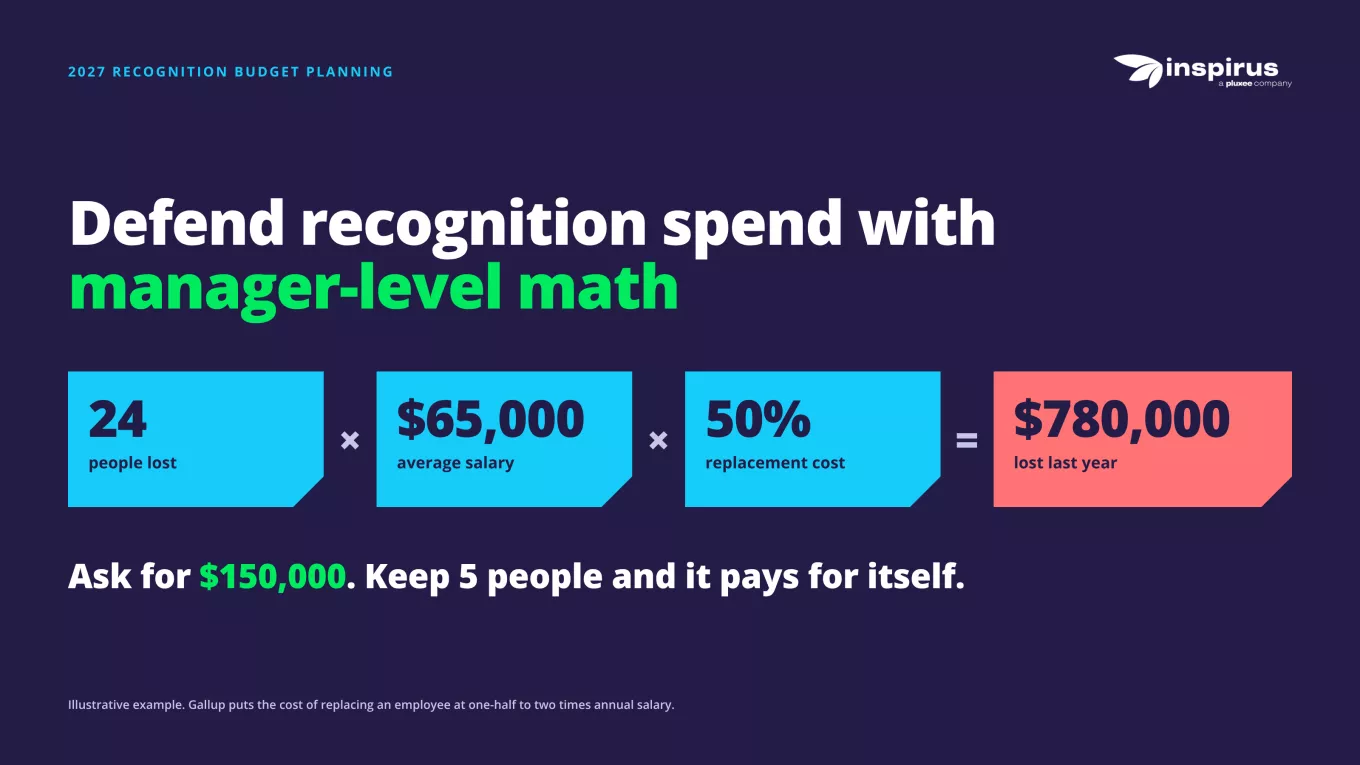
"We lost 24 people last year across three hard-to-fill roles. At an average salary of $65,000 and a conservative replacement cost of half a year's pay, that's $780,000. We're asking for $150,000 for a recognition plan aimed at those teams, without adding another spreadsheet for managers. If it keeps 5 of those people, it pays for itself. Here's the even-split version if we change nothing."
Swap in your own figures from the turnover cost calculator and the structure holds. Finance now has a decision to make, with the cost of saying no on the same page.
5. Pair the calculators with the budget model
The calculators show why the money matters. The 2027 Recognition Budget Planner sets the annual total from your own turnover costs, and the Recognition Budget Model shows where it goes, department by department, next to an even split. If you haven't made that comparison yet, here's why an even split rarely holds up for 2027.
Use both when the meeting is about 2027 planning rather than a one-off program refresh.
Culture is the reason recognition matters. The math is how it gets funded. Before your next budget review, open the Recognition ROI Hub and run the two calculators that match your toughest objection. If you want help building the case, talk with an Inspirus specialist.
FAQs
Which recognition ROI calculator should I start with?
Start with the objection you expect. Turnover cost fits retention concerns, admin burden fits manager workload, and productivity or disengagement fits a request to prove ROI.
How do I build a recognition business case finance will accept?
Put the cost of the problem in dollars, use finance's own inputs, and make a specific ask with an alternative. Our five-step guide to making the business case for employee recognition covers the full structure.