The State of Employee Experience and Recognition in 2025
What Inspirus Data Reveals About Engagement, Disengagement, and Recognition Maturity
As organizations closed the books on 2025, HR leaders find themselves navigating an increasingly complex landscape. Global employee engagement has dropped to 21%, matching pandemic-era lows and representing the first significant decline in four years. The pressures are mounting, the costs are measurable, and the solutions remain elusive for many.
To better understand how organizations are responding to these challenges, Inspirus analyzed first-party data from employee experience calculators and Recognition Maturity Model assessments on experience.inspirus.com. This analysis reflects how organizations are evaluating their own workforces, not benchmarks, projections, or assumptions, but real assessments of disengagement, productivity loss, turnover, and recognition strategy effectiveness.
What emerged is a clear picture of where recognition stands today, how much disengagement is costing organizations, and why many recognition strategies still aren't delivering their full potential.
Understanding the Data: Who This Represents
This analysis draws from organizations that engaged with Inspirus tools throughout 2025. These companies span industries and regions, with an average organization size of 2,400 employees. The data comes directly from self-reported inputs by HR and People leaders who are actively assessing their employee experience challenges.
This is first-party, directional data, not industry averages or theoretical models, but real-world assessments from organizations grappling with the same questions you are: How disengaged is our workforce? What is this costing us? Where do we stand on recognition maturity? And how can a recognition and engagement strategy help us achieve our goals?
The answers, as we'll see, point to both significant risks and untapped opportunities.
The Hidden Epidemic: Disengagement's Staggering Financial Toll
If there's one employee experience challenge that towers above the rest, it's disengagement. Industry research confirms that disengagement can cost midsize companies between $228 million and $355 million annually, and the Inspirus data reveals just how widespread this issue has become.
Among organizations using the Inspirus Disengagement Cost Calculator, the average company reported:
- 110 actively disengaged employees
- 350 partially disengaged employees
The financial impact of this disengagement is striking:
- $2.46M lost annually from actively disengaged employees
- $3.92M lost annually from partially disengaged employees
That's more than $6.3M in annual productivity loss per organization, on average.
To put this in perspective, these figures represent real dollars disappearing from organizational performance, not through market downturns or competitive pressures, but through the quiet erosion of motivation, effort, and commitment. Globally, disengagement costs the economy $8.8 trillion in lost productivity, and every organization carries its share of this burden.
This data reinforces an important truth for HR leaders: disengagement is not simply a morale issue or an engagement survey score. It is a material business risk that compounds over time when left unaddressed, affecting everything from innovation to customer service to operational efficiency.
Source: Inspirus Disengagement Cost Calculator
Beyond Disengagement: The Compounding Costs of Experience Erosion
While disengagement represents the largest single financial impact, it rarely exists in isolation. The Inspirus data reveals consistent erosion across multiple employee experience indicators, each contributing to organizational strain.
The Productivity Drain
When employees are disengaged, their output suffers. Organizations using the Productivity ROI Calculator reported an average annual productivity impact of $104,604. While this figure may seem modest compared to disengagement costs, it often reflects only a portion of the true performance loss, particularly in environments where recognition is inconsistent or disconnected from daily work.
Research shows that highly engaged teams are 23% more productive than their counterparts, suggesting that the gap between current performance and potential is substantial. This productivity loss manifests in missed deadlines, lower quality work, reduced innovation, and decreased responsiveness to customer needs.
Source: Inspirus Productivity ROI Calculator
The Silent Signal: Absenteeism
Absenteeism continues to surface as a meaningful cost in the Inspirus data, with an average annual impact of $222,325 per organization. This metric is particularly telling because it often signals deeper issues before they become visible in engagement surveys or exit interviews.
When employees begin calling in sick more frequently, arriving late, or taking extended breaks, it's frequently a symptom of burnout, disconnection, or lack of psychological safety. Absenteeism correlates strongly with disengagement and poor recognition practices, creating a feedback loop where absent employees fall further behind, feel less connected, and become more likely to disengage entirely.
Source: Inspirus Absenteeism Cost Calculator
Turnover: The Final Act in a Longer Story
The average reported annual cost of employee turnover in the Inspirus data stands at $184,814. Industry research suggests replacement costs can range from 50% to four times an employee's annual salary, depending on the role and level.
However, what the data increasingly reveals is that turnover is a symptom rather than a starting point. In most cases, disengagement, declining productivity, and increased absenteeism appear well before an employee decides to leave. By the time someone resigns, the organization has often already absorbed months of reduced contribution and diminished engagement, which can often times lead to toxic workplace cultures.
Recognition strategies that fail to scale or remain consistent often miss the critical window to intervene, that moment when an employee transitions from engaged to questioning their commitment. The cost of turnover, then, isn't just the replacement expense; it's the accumulated loss of productivity, institutional knowledge, and team cohesion that preceded the departure.
Source: Inspirus Turnover Cost Calculator
The Recognition Maturity Gap: Why These Costs Persist
Given the clear financial impact of disengagement and experience erosion, why do these problems persist? The answer lies in how organizations approach recognition.
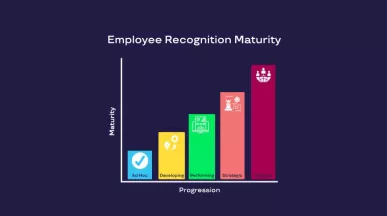
To understand the current state of recognition strategy, Inspirus analyzed results from the Recognition Maturity Model Quiz, which assesses organizations across five distinct levels:
| Maturity Level | Score Range | Characteristics |
| Ad Hoc | 8–11 | Recognition is irregular and manager-dependent |
| Developing | 12–18 | Some programs exist but lack consistency |
| Structured | 19–23 | Systematic recognition with clear processes |
| Strategic | 24–27 | Recognition drives business outcomes |
| Cultural | 28–32 | Recognition embedded in organizational DNA |
The Reality Check
Across all of the completed assessments, the results painted a sobering picture:
- Average score: 18.4
- Score range: 8 to 32
- Most common level: Developing
The average score places organizations firmly in the Developing stage of recognition maturity. This means that while most companies have taken initial steps toward structured recognition, they haven't yet reached the levels where recognition becomes a reliable driver of engagement, performance, and retention.
What Developing Stage Actually Means
Organizations at the Developing stage typically demonstrate:
- Some recognition programs in place, but often limited to annual awards or manager-initiated moments
- Inconsistent application across teams, departments, or locations. What happens in one area may not happen in another
- Minimal measurement of recognition's impact on business outcomes
- Limited connection between recognition and strategic priorities
- Recognition viewed as HR's responsibility rather than a shared leadership capability
While pockets of higher maturity exist, some organizations scored as high as 32, indicating Cultural-level recognition, the overall data suggests that most companies have not yet progressed to the Structured, Strategic, or Cultural levels where recognition becomes transformational.
Source: Inspirus Recognition Maturity Model Quiz & Framework
Related reading: Is Your Employee Recognition Program Stuck in the 80s?
Connecting the Dots: The 2025 Recognition Reality
When viewed together, the Inspirus data reveals a consistent and concerning pattern:
The Problem is Clear:
- Disengagement is costing organizations millions annually
- Productivity and absenteeism reflect ongoing experience strain
- Turnover surfaces as a downstream outcome of earlier breakdowns
- Recognition strategies remain developmentally immature relative to the challenges they need to address
The Opportunity is Evident:
Despite being one of the most scalable and measurable employee experience levers available, recognition is still treated as episodic rather than strategic in most organizations. Employee engagement is 14% higher in companies with recognition programs, yet the maturity data shows that most organizations haven't built recognition systems capable of delivering sustained impact.
The Gap in 2025:
The issue isn't awareness, most HR leaders understand that recognition matters. The gap is execution. Organizations know they should recognize employees more consistently, but they lack the systems, training, and cultural reinforcement to make it happen at scale. (Looking for a playbook on how to create a winning recognition strategy? Check out our playbook!)
This execution gap explains why employee experience costs remain stubbornly high even as organizations invest in engagement initiatives. Without mature recognition systems that connect daily experiences to organizational values, performance expectations, and individual contributions, those investments fail to gain traction.
Looking Ahead: What This Means for HR Leaders in 2026
As organizations plan for the year ahead, the implications of this data become strategic imperatives rather than nice-to-have initiatives.
Recognition Must Evolve
The traditional approach—ad hoc appreciation, annual awards, and manager-dependent recognition—is insufficient for the challenges organizations face. With manager engagement falling from 30% to 27% globally, organizations cannot rely solely on managers to drive recognition without providing them with systems, support, and skills.
Recognition must evolve from isolated moments to an integrated system that reinforces values, performance, and belonging at every level of the organization.
Maturity Becomes Competitive Advantage
Organizations that progress along the recognition maturity curve position themselves to:
- Reduce disengagement-driven losses by catching early warning signs and reinforcing positive behaviors
- Improve productivity and attendance through consistent appreciation that strengthens commitment
- Strengthen culture during change by anchoring employees to shared values and purpose
- Intervene earlier to prevent unwanted turnover by addressing disconnection before it becomes resignation
The data shows that the cost of inaction—$6.3M in disengagement losses alone—far exceeds the investment required to build mature recognition systems. Organizations utilizing recognition software are 28% more likely to report positive ROI from their employee experience investments.
Recognition as Business Strategy
In 2026 and beyond, recognition can no longer be relegated to HR programs and initiatives. It must become a core business strategy—measured, resourced, and embedded into how work gets done. The organizations that make this shift will be the ones that protect and amplify their employee experience while their competitors continue to absorb millions in preventable losses.
Recognition is no longer just about appreciation—it's about protecting organizational capability, preserving institutional knowledge, and amplifying the human potential that drives business results.
Take Action: Assess Your Recognition Maturity and Employee Experience
The data tells a story, but your organization writes its own chapter. The question isn't whether you have employee experience challenges—the question is how much they're costing you and whether your recognition strategy is mature enough to address them.
Understand where your organization stands:
Use the Inspirus Recognition Maturity Model and employee experience calculators to uncover your current state and identify where opportunity exists. These assessments provide concrete, data-driven insights into the financial impact of disengagement and the strategic gaps in your recognition approach.
Discover your baseline. Identify your opportunities. Build your roadmap.
Assess your Recognition Maturity and Employee Experience
The future of employee experience isn't about doing more—it's about doing what matters, consistently, at scale. Recognition is how you make that happen.


Related articles